

Applying Psychology to Motivate Employees (Part 1) | Safe and Sound
Motivating employees is not simply about increasing salaries or rewards. Psychology has shown that, in order for employees to be truly motivated to work, it is necessary to influence psychological factors such as needs, emotions, perceptions and intrinsic motivation. So how to apply psychology to motivate employees? In the article below, Safe and Sound's psychological experts will help you better understand important psychological principles and how to apply them to promote the working spirit of the staff.
Ngo Thi Sang | Master of Educational Psychology – Applied mental health care Safe and Sound
Institute of Medical Technology Applications
1. Applying Maslow's hierarchy of needs in human resource management
Abraham Maslow's hierarchy of needs is one of the most popular psychological theories of human motivation, especially valuable when applied to human resource management. According to Maslow, humans have five basic levels of needs, arranged in order from low to high.
Psychologists say that in the work environment, if employees' basic needs are not fully met, it will be difficult for them to maintain motivation and dedication in the long term. Therefore, managers need to understand each level of need to have appropriate strategies to promote employee morale.
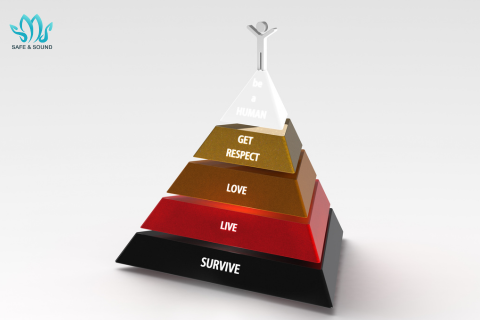
Applying Maslow's hierarchy of needs
How to apply the hierarchy of needs to the work environment:
- Physiological needs (Salary, bonus, benefits): This is the most basic need, including essential factors such as salary, benefits, medical benefits and allowances. A stable salary that is commensurate with the effort put in will help employees feel secure in their work, without having to worry or stress about daily financial issues. In addition to salary, support policies such as free lunch, travel allowance or flexible working regime also help employees maintain better health and working spirit.
- Safety needs (Job stability, insurance, safe working environment): Employees will be more motivated to work when they feel their job is stable and not threatened by stress and risks such as sudden dismissal or dangerous working conditions. Businesses need to ensure a safe working environment, with full insurance policies, clear labor contracts and a specific career development path. When employees feel their job is stable, they will tend to stick with the organization for a long time.
- Social needs (Connection, corporate culture): Humans are social creatures and the workplace is no exception. When employees feel they belong to a group, connected with colleagues and leaders, they will be more motivated to work. Businesses can promote this need by building an open corporate culture, organizing bonding activities such as team building, internal events, team bonding programs and creating open workspaces to encourage communication. A united and understanding team will help increase productivity and job satisfaction.
- Need for respect (Recognition of achievements, promotion opportunities): Employees not only need a stable job but also want to be recognized for their contributions. When a person feels valued and appreciated, they will have a stronger motivation to continue to strive. Businesses should build a transparent performance evaluation system, promptly reward employees when they achieve outstanding achievements, and provide clear promotion opportunities so that employees can develop their long-term careers. In addition, words of encouragement from leaders also have a strong impact on employee morale.
- Self-actualization needs (Creativity, personal development): This is the highest need in Maslow's pyramid and is also the driving force that helps employees reach new heights. A meaningful job that provides creative opportunities will help employees feel satisfied and have the desire to contribute long-term. Businesses can meet this need by empowering employees more, encouraging them to propose new ideas, providing in-depth training courses and creating conditions for them to participate in more challenging projects. Psychologists say that when employees have the opportunity to develop themselves, they will stick with their jobs and organizations for a long time.
2. Application of Herzberg's two-factor theory
Frederick Herzberg, a famous psychologist in the field of management and work motivation, developed the two-factor theory to explain why employees are motivated or not. According to him, work motivation is not only dependent on material factors such as salary or benefits, but is also influenced by psychological factors, such as recognition and growth opportunities.
Herzberg divided work motivation into two main groups of factors:
- Hygiene factors
When these factors are lacking, employees may feel dissatisfied, frustrated or want to quit. However, even when these factors are guaranteed, they only help employees maintain a state of satisfaction, but do not create a breakthrough in work motivation.
- Salary and benefits: A stable salary that is commensurate with the effort put in helps employees feel secure in their work. If the salary is too low or there is no reasonable bonus system, they will easily lose motivation.

Working conditions affect employee motivation
- Working conditions: A safe, comfortable working environment with full support equipment helps employees work more effectively. An airy working space with a rest area and health support policies also helps reduce stress and increase satisfaction.
- Relationship with superiors and colleagues: Employees need to work in an open environment with good communication between members. If the working environment is full of stress, negative competition or conflicts with management, employees will easily lose morale and motivation to work.
- Company policies: Promotion policies, flexible working regimes, and reasonable working hours all affect employee psychology. If policies are unfair or unclear, employees will feel unappreciated.
- Motivators
This is the group of factors that really creates strong motivation for employees. If businesses only focus on the group of maintenance factors and ignore the motivating factors, employees will feel that their work lacks challenge and motivation to develop.
- Promotion opportunities: If the company does not have promotion opportunities or does not recognize employees' efforts, they will easily lose motivation to work and look for other opportunities.
- Recognition: A compliment, a small reward, or an email acknowledging an achievement can help employees feel valued and recognized.
- Level of job challenge: When the job is innovative, requires employees to be creative or overcome new challenges, they will be more motivated to develop themselves.
- Meaning of work: Employees are often more motivated to work when they feel their work is meaningful, contributing to the company, society or helping others. Businesses can create a work environment where employees feel that they are doing something important, rather than simply making money.
How to apply herzberg theory in human resource management
According to psychological experts, to apply this theory in practice, businesses need to ensure both groups of factors in parallel :
1. First, eliminate the factors that cause dissatisfaction by ensuring fair wages, creating good working conditions, having clear policies and building a friendly working environment.

Create development opportunities for employees
2. Next, focus on creating real motivation by providing development opportunities, recognizing employee achievements, creating challenging work, and helping employees find meaning in their work.
3. Using Vroom's Expectancy Theory
Expectancy theory, developed by Victor Vroom in the 1960s, helps explain employee motivation based on the link between effort, performance, and rewards. According to Vroom, employees will be more motivated when they believe that:
- Their efforts will produce good results (Expectancy).
- That good result will bring worthy reward (Instrumentality).
- The reward received is valuable to them (Valence).
Three elements of expectancy theory
1. Expectancy: This is the employee's belief that their efforts will lead to the desired results. If employees feel that their efforts are not effective, they will easily become discouraged.
For example, if employees believe that no matter how hard they work, they cannot achieve their goals because company processes are too complicated or lack support, they will not be motivated.
2. Instrumentality: This is the extent to which employees believe that if they achieve good results, they will be rewarded accordingly.
If employees feel that their company's performance appraisals are unfair or that there is no clear reward system, they will have no motivation to work hard. But if they know that their performance will be recognized and evaluated objectively, they will be more motivated to work hard.
3. Valence: This is the extent to which employees value the rewards they receive. Not all rewards are meaningful to everyone.
-
- For some employees, a raise or bonus is a strong motivator.
- For others, advancement opportunities, skill training, or recognition from leadership are more important.
.png)
How to apply expectancy theory to human resource management
- Set clear and achievable goals
-
- Employees need to know exactly what is expected of them and how to achieve goals.
- Businesses should provide the tools, training, and support needed to help employees meet expectations.

Provide necessary support to employees
- Building a transparent and fair reward system
-
- When employees achieve, they need to be evaluated clearly, fairly and consistently.
- If two people with similar performance receive different bonuses, employees will feel unfair and lose motivation.
- Design rewards that match employee desires
- Listen to your employees' needs to find out what they really value. Some may want a bonus, while others may be in the mood for more vacation time or training opportunities.
-
-
- The reward system can be diverse: monetary rewards, recognition of achievements in front of the group, promotion opportunities, advanced training courses...
-
Safe and Sound Clinic - Family health and psychological support
With a team of experienced doctors and specialists, Safe and Sound Clinic is a pioneer in comprehensive health care with health care services from medicine to psychology.
“Early prevention - Timely support - Long-term companionship”.
If you have any doubts or experience any physical or mental health problems, please contact HOTLINE 0964 778 911 (Phone/Zalo, 24/7) for answers and support as soon as possible!
HOW TO MAKE AN APPOINTMENT for online or in-person consultation with an expert
- At SnS Clinic - IMT Institute
- Or download and schedule a consultation on the Safe and Sound app to manage and track your schedule anytime, anywhere.
Safe and Sound (SnS) - Institute of Applied Medical Technology (IMT)

See also:
- How to promote employees' intrinsic motivation, leaders need to know
- 6 ways to stay motivated in work and life
- Increase motivation – increase productivity through happy hormones
